

Key takeaways
AI helps immigration lawyers streamline tasks like drafting, form prep, translation, and client communication.
Government agencies are using AI for fraud detection, document review, and immigration case management.
Clients are using AI to organize documents and prepare for cases, but legal strategy still requires an attorney.
Lawyers must stay current on the ethical and regulatory implications of AI in immigration law.
Artificial intelligence is becoming an essential tool in immigration law, not because it’s flashy or futuristic, but because it meets a very real need. Lawyers are managing rising caseloads, tight deadlines, evolving policies, and clients who expect fast, clear communication. AI offers a way to reduce the time spent on repetitive tasks and free up more capacity for complex, high-value work.
Rather than replacing attorneys, AI functions as a support layer within legal workflows. It can handle responsibilities like organizing documents, generating drafts, or capturing case details from client records. With the right tools in place, attorneys can focus more of their time on strategic thinking, advocacy, and client relationships.
This article explores how AI is being used in immigration law today, what tools are available, and how both law firms and government agencies are adapting. As technologies continue to evolve, understanding their capabilities and limitations is an important step toward building a more efficient, future-ready practice.
What is AI in immigration law?
AI in immigration law refers to the use of artificial intelligence tools by legal professionals and government agencies to work more efficiently and manage complex information. At law firms, it’s a tool for automating tasks and improving client service. In federal agencies, it’s used for pattern detection, document analysis, and large-scale data management. Understanding AI adoption in both of these areas gives context to how the technology is gradually reshaping the inner workings of the immigration pipeline.
AI technology overview
To understand what legal AI can do, it helps to look at the underlying technologies that make it possible. These include:
Natural language processing (NLP): Enables computers to understand, interpret, and generate human language, supporting tools like legal writing assistants and chatbots.
Machine learning: Allows software to improve performance over time by identifying patterns in data, often used for tasks like document classification or predictive modeling.
Automation: Uses rule-based logic or AI-driven decision-making to complete repetitive tasks without human intervention, such as auto-filling forms or organizing case files.
Predictive analytics: Analyzes data to anticipate future outcomes or flag potential issues, such as case delays or compliance risks.
Top AI use cases for immigration lawyers
Clients may never see the AI tools their attorneys use, but they feel the impact. Faster responses, clearer communication, and fewer delays are often the result of behind-the-scenes automation. Here’s how immigration lawyers are using AI to create a more efficient and responsive experience.
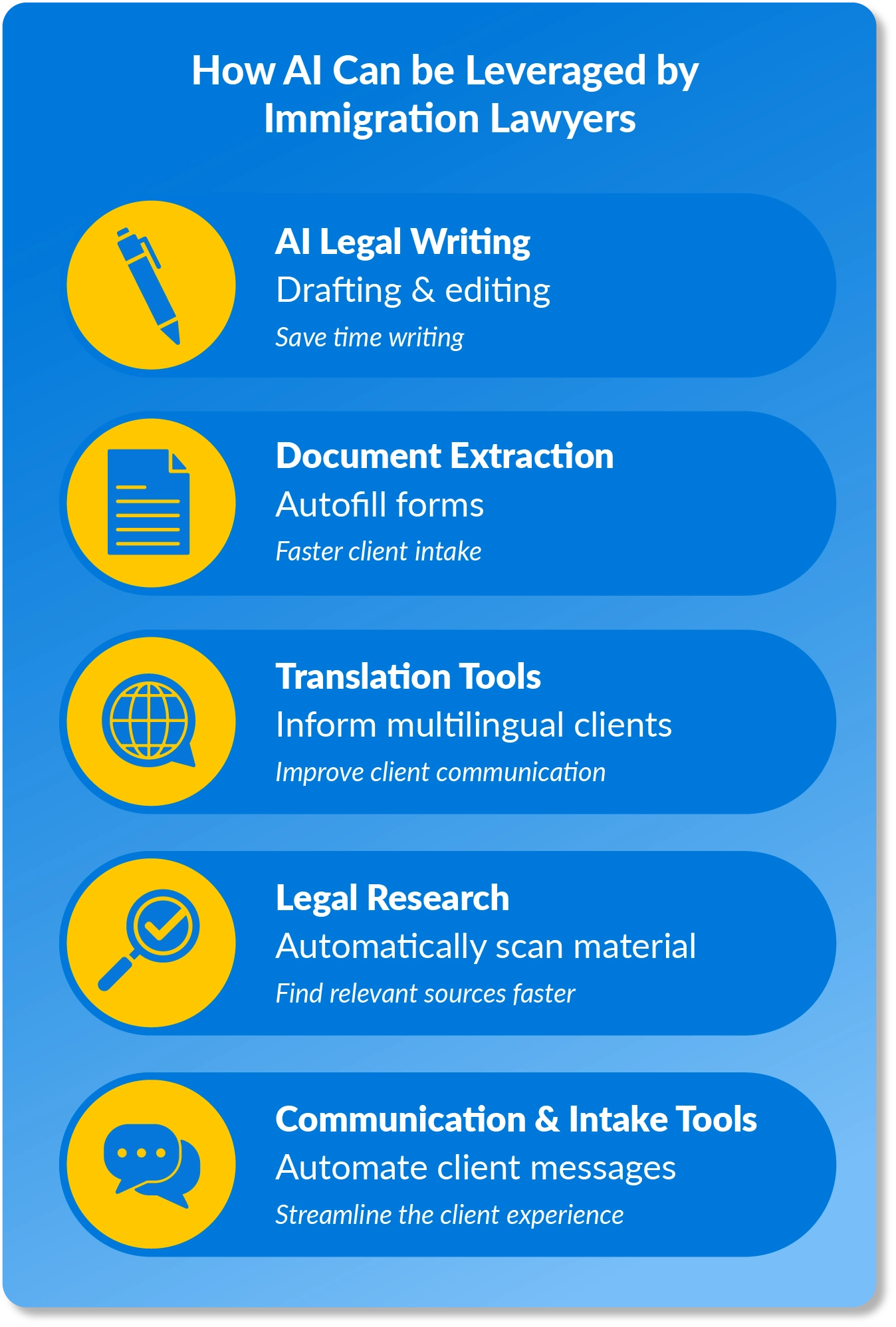
AI-enhanced legal writing and drafting efficiency
Immigration attorneys manage a wide range of writing tasks, from detailed legal briefs to quick client updates. AI legal writing tools can help streamline this work by generating drafts, refining language, and translating content when needed.
These tools use natural language processing to support formal and informal writing across multiple formats, saving attorneys time while improving consistency and tone. Rather than starting from scratch or manually editing dense text, attorneys can use generative AI to move through written tasks more efficiently and focus on the content that requires deeper legal judgment.
Key features and outcomes:
Generates initial drafts for legal documents, notices, and client communications
Provides proofreading and editing suggestions to improve tone and clarity
Translates written content to support multilingual client needs
Speeds up document creation while reducing manual revisions
Helps maintain consistency across case documentation and templates
AI-enabled document extraction and evidence processing
AI document extraction tools can scan passports, visas, green cards, and other supporting documents to automatically capture key client information. Instead of manually entering names, birthdates, and ID numbers, attorneys and staff can rely on AI to populate immigration forms with greater speed and accuracy.
This type of automation helps streamline the intake process, reduce errors, and free up staff to focus on more complex tasks. As a result, firms can move cases forward faster and take on more clients without increasing administrative burden.
Key features and outcomes:
Scans and captures data from photos or scans of official documents
Auto-fills client details across immigration forms and internal systems
Reduces manual data entry and the risk of clerical errors
Speeds up intake and evidence review timelines
Helps firms manage higher caseloads with less administrative overhead
AI-assisted translation and multilingual support
Clear communication is essential in immigration law. AI-powered translation tools help bridge language gaps by quickly and accurately translating documents, messages, and form responses. This makes it easier for attorneys to gather information and keep clients informed.
Key features and outcomes:
Translates written content across dozens of languages in real time
Enables faster review of multilingual client documents
Enhances communication with clients throughout the immigration process
Reduces delays caused by language barriers
Supports more inclusive, accessible legal services
Legal research and case strategy support
Immigration law AI tools can scan large volumes of case law, memos, and statutory materials in a fraction of the time it would take to do so manually. This gives immigration lawyers a faster way to find relevant precedents, analyze similar cases, and test potential arguments. While AI doesn’t replace legal reasoning, it helps surface key insights attorneys can use to shape a more informed and strategic approach.
Key features and outcomes:
Speeds up the process of finding relevant legal sources
Surfaces related cases and precedents based on facts
Assists in identifying legal arguments or strategy options
Supports memo drafting by summarizing legal references
Reduces research time while helping attorneys stay thorough
Client communication and intake automation
AI is making it easier for firms to manage communication and onboarding without creating bottlenecks. From automated follow-ups to smart intake forms, AI tools for immigration lawyers can streamline the client experience while keeping teams organized. This reduces the need for repetitive outreach and helps ensure no critical information falls through the cracks.
Key features and outcomes:
Sends automated reminders and follow-up emails to clients
Supports chatbot-style intake that collects case details up front
Flags missing information in submitted forms or questionnaires
Reduces back-and-forth during client onboarding
Helps teams stay responsive without adding to their workload
Leading AI platforms for immigration lawyers in 2026
With a growing number of legal AI tools on the market, immigration lawyers now have a range of options to choose from, each with different capabilities, pricing models, and use cases. Some of the top AI immigration platforms are designed to support solo attorneys with automated drafting and intake, while others offer more robust features for growing firms managing heavy caseloads.
When comparing AI immigration platforms, it’s worth considering not only how they fit into your existing workflows but also how they affect the client experience. Below, we highlight several leading AI-powered solutions and what sets each one apart.
Solution | Primary focus & strengths | Typical use cases/core features |
DocketWise | All-in-one immigration case management with built-in AI tools | AI-assisted drafting and translation, automated extraction from client documents, Smart Form population, seamless transition from intake to case prep |
Visalaw.ai | Immigration-specific legal research, document drafting, and analysis | Finds relevant statutes and precedents quickly, drafts motions/letters, summarizes legal sources, supports case strategy |
DraftyAI.com | Automation of drafting immigration filing documents and client correspondence | Generates immigration forms, notice letters, and cover letters; uses editable templates; speeds up repetitive drafting work |
Legal Bridge | Streamlined intake and workflow automation for immigration law firms | Drag-and-drop intake with auto-filled forms, document generation, status tracking, and integrations with case management and CRM tools |
Parley | Automated legal research, RFE response support, and real-time USCIS case tracking | Generates AI-assisted drafts of visa petitions, forms, and support letters aligned with current USCIS guidance |
DocketWise IQ
DocketWise is a comprehensive immigration case management solution with built-in AI tools that streamline key parts of the legal workflow. Its AI suite, Docketwise IQ, helps reduce manual work while improving speed, accuracy, and clarity. With writing, translation, and data extraction tools housed in a single system, attorneys can move from document intake to case preparation more efficiently, without the usual administrative slowdowns.
Key tools and outcomes:
Docketwise IQ writing assistant: Drafts legal documents, client emails, case summaries, and form responses quickly and with a professional tone. Also supports translation between languages such as English and Spanish.
Docketwise IQ document assistant: Extracts names, dates, ID numbers, and other details from passports, visas, green cards, I-94s, and similar records, then auto-fills Smart Forms with this information. This reduces errors, saves time, and simplifies intake and evidence review.
Visalaw.ai
Visalaw.ai is a legal AI platform for immigration attorneys, with tools designed to support research, drafting, and legal analysis. Developed in collaboration with immigration law experts, the platform offers specialized features that help attorneys review complex materials faster and strengthen their written work with AI-generated insights.
Key tools and outcomes:
AI immigration law research assistant: Analyzes case facts and surfaces relevant statutes, regulations, and policy memos
Drafting support: Generates letters, motions, and other legal documents based on user input and case context
Immigration-specific knowledge base: Tailored to the nuances of U.S. immigration law for more reliable outputs
Drafty.ai
Drafty.ai is a newer platform focused on automating one of the most time-consuming tasks in immigration practice: document drafting. Its tools are designed to quickly generate forms, notices, and cover letters based on firm preferences and case details, helping attorneys and staff cut down on repetitive writing work.
Key tools and outcomes:
Immigration form drafting: Builds customized drafts for a wide range of common immigration filings
Client communications: Creates client-facing letters and internal notices with editable templates
Smart document templates: Offers reusable templates that reflect a firm’s voice and format preferences
Legal Bridge
Legal Bridge offers AI-powered workflows that streamline intake, document handling, and firm operations for immigration law practices. The platform reduces administrative complexity by automating routine steps and syncing data across systems, helping firms stay organized and efficient throughout the case lifecycle
Key tools and outcomes:
Simplified intake tools: Enables users to drag and drop documents, extract key details, and automatically populate forms
Workflow automation: Streamlines common tasks like document generation, intake routing, and status updates
Cross-platform integration: Connects with existing case management, CRM, and billing tools to eliminate duplicate data entry
Designed for immigration law: Tailored for the needs of immigration attorneys handling high-volume caseloads
Parley
Parley is an AI platform built for immigration law professionals to automate document drafting, legal research, evidence handling, and case tracking. It helps attorneys assemble visa applications and related filings more efficiently by combining document extraction, integrated workflows, and real-time updates, all while keeping lawyers in control of strategy and review.
Key tools and outcomes:
AI legal research assistant: Answers questions about immigration law using citations from articles, policy memos, and regulations
RFE response support: Helps draft clear, well-supported responses to Requests for Evidence using relevant legal sources
Case tracking: Integrates with the USCIS API to notify attorneys about case updates in real time
AI in immigration industry trends for 2026
There are uses for AI in nearly every stage of the U.S. immigration system, from the tools applicants use to manage documentation to the technologies federal agencies deploy for case management and enforcement.
In 2026, the latest news on AI in the immigration industry shows that this ecosystem is expanding rapidly. New apps and online assistants are making it easier to organize materials, translate documents, and navigate early-stage steps on their own. On the institutional side, immigration authorities are continuing to pilot and adopt AI systems that handle tasks like fraud detection, document validation, and inquiry triage.
For immigration lawyers, these AI immigration industry trends reflect a broader shift. Legal AI technology is no longer confined to internal firm operations. It's becoming part of the broader environment in which cases are prepared, reviewed, and decided.
How clients can use AI in their immigration journey
As AI tools become more accessible, many individuals navigating the immigration process are using them to stay organized and better understand the road ahead. These tools can be helpful for handling basic tasks and preparing information before a lawyer gets involved. But there are some limits to what AI can and should do when it comes to legal decision-making.
What AI can help clients do:
Organize supporting documents and identify missing materials
Translate forms, instructions, and correspondence into their preferred language
Draft basic messages or questions to send to their legal representative
Flag inconsistent or incomplete information before submitting paperwork
What AI should not be used for:
Providing legal advice or customizing strategies for individual immigration cases
Assessing an applicant’s eligibility or evaluating supporting evidence
Interpreting frequently changing immigration laws and official procedures
Acting as a substitute for legal representation
AI use cases in federal government immigration services
United States Citizenship and Immigration Services (USCIS) and Immigration and Customs Enforcement (ICE) currently have several AI-enabled processes, including:
Facial recognition for investigating child exploitation cases: AI is used to identify victims and perpetrators in photographic evidence. Human analysts confirm any matches before enforcement actions are taken.
Compliance risk scoring for non-detained noncitizens: Known as the Hurricane Score, this AI model predicts whether individuals are likely to comply with their release conditions while awaiting further proceedings.
Translation to support Homeland Security Investigations (HSI): AI tools translate written and recorded materials into English to assist in investigations related to organized crime, trafficking, and cybercrime.
Intelligent document processing: U.S. Immigration and Customs Enforcement (ICE) uses AI to streamline administrative tasks such as invoice creation, data validation, and information extraction from government records.
Automated fraud detection and pattern analysis: AI systems help identify suspicious trends in applications or documents that may indicate fraud or misrepresentation, allowing for earlier intervention.
Triage of inquiries and service requests: AI tools categorize and route incoming questions from applicants and legal representatives, helping agencies prioritize urgent requests and reduce response times.
In 2025, the Department of Homeland Security released the Generative AI Public Sector Playbook to support the responsible development and use of these tools across federal agencies. While the guidelines aim to promote efficiency and consistency, AI-powered identity, background, and fraud checks may still flag issues that require manual review. Staying organized and thorough in documentation can help lawyers and clients respond quickly and minimize delays.
Ethical concerns for using AI in immigration cases
Immigration AI can deliver a range of benefits, but it’s not without potential risks. Advocacy groups and legal experts have expressed concerns about the government's use of AI in immigration case handling. Additionally, lawyers have shared reservations about using immigration AI in their practices.
Government use of AI
Critics argue that incorporating AI into immigration procedures could potentially violate privacy rights and civil liberties and even introduce bias against minority groups.
These concerns center on automated decision-making. Technology-driven checks and verifications require sensitive data to be shared for processing. This potentially exposes personal information and raises questions about the appropriate handling and use of immigration case data. Due process may also suffer if AI replaces human oversight and analysis.
Bias, a known problem within AI algorithms, could have the most damaging impact on immigration handling. It can be difficult to detect and correct bias, but it can have far-reaching implications when AI tools are used at scale.
Legal practice use of AI
Some immigration lawyers have been hesitant to use AI in their practices because the technology can produce inaccurate information. Relying on immigration AI without review and source verification can result in inaccurate or misleading legal briefs and documents. This may violate immigrants' rights and potentially constitute legal malpractice.
However, when used responsibly, AI can serve as a powerful tool to enhance efficiency, support legal research, and better client outcomes, a benefit many immigration lawyers have been experiencing.
Ensuring fairness in the AI era
Legislators in and outside the legal community are taking steps to ensure AI does not encroach on fair and accurate legal processes. Examples include:
The Court of King’s Bench in Manitoba, Canada, requires litigants to disclose whether and how they used AI in their submissions.
In 2023, a large group of public interest organizations urged Congress in writing to develop legislation that would place guardrails on AI to ensure marginalized groups retain equal rights.
In 2024, the European Artificial Intelligence Act (AI Act) went into effect to promote the safe use of AI.
The Florida Bar published Opinion 24-1 outlining how lawyers may use AI safely in client representation. The opinion emphasizes the lawyer's responsibility to protect the confidentiality of client information.
How to learn more about legal AI and immigration
The field of legal AI is complex and evolving. Therefore, immigration lawyers can benefit from ongoing education and learning in this area. Four reputable resources to reference are:
DocketWise AI Blog: The DocketWise AI blog covers AI developments as they relate to immigration law.
MyCase AI Resource Center. MyCase offers a central hub of articles, guides, and resources on AI for immigration lawyers and other legal professionals.
DocketWise ChatGPT eBook: The DocketWise ChatGPT eBook explores how AI can reshape immigration law firms through automation. The book includes practical advice on AI prompting, which can be a hurdle for new users.
DocketWise Immigration Uncovered Podcast: Immigration Uncovered supports new and successful immigration law firms by tackling a range of topics, including AI, immigration policy, digital marketing, and more.
How DocketWise IQ is elevating AI for immigration lawyers
DocketWise IQ is designed specifically to help immigration lawyers work more productively with the support of AI. The DocketWise IQ document assistant automatically populates immigration forms using stored client documents and generates summaries in seconds, while the DocketWise IQ writing assistant efficiently edits written communications. These tools integrate seamlessly with DocketWise case management and translation capabilities, creating a more streamlined experience for both attorneys and staff.
Now available to DocketWise users, DocketWise IQ represents a meaningful step forward in building smarter, more responsive immigration workflows.
Schedule a demo today to see how AI-powered DocketWise can help you stay organized and handle cases more efficiently.
Immigration AI FAQs
Transform Your Practice with ChatGPT
Discover how AI, particularly ChatGPT, can revolutionize your practice, from automating tasks to mastering effective prompting.
Download Now
About the author

Rob Heidrick is a Senior Content Strategist for Docketwise, a leading professional business solution. He covers the latest advancements in legal technology, financial wellness for law firms, and key industry trends.


